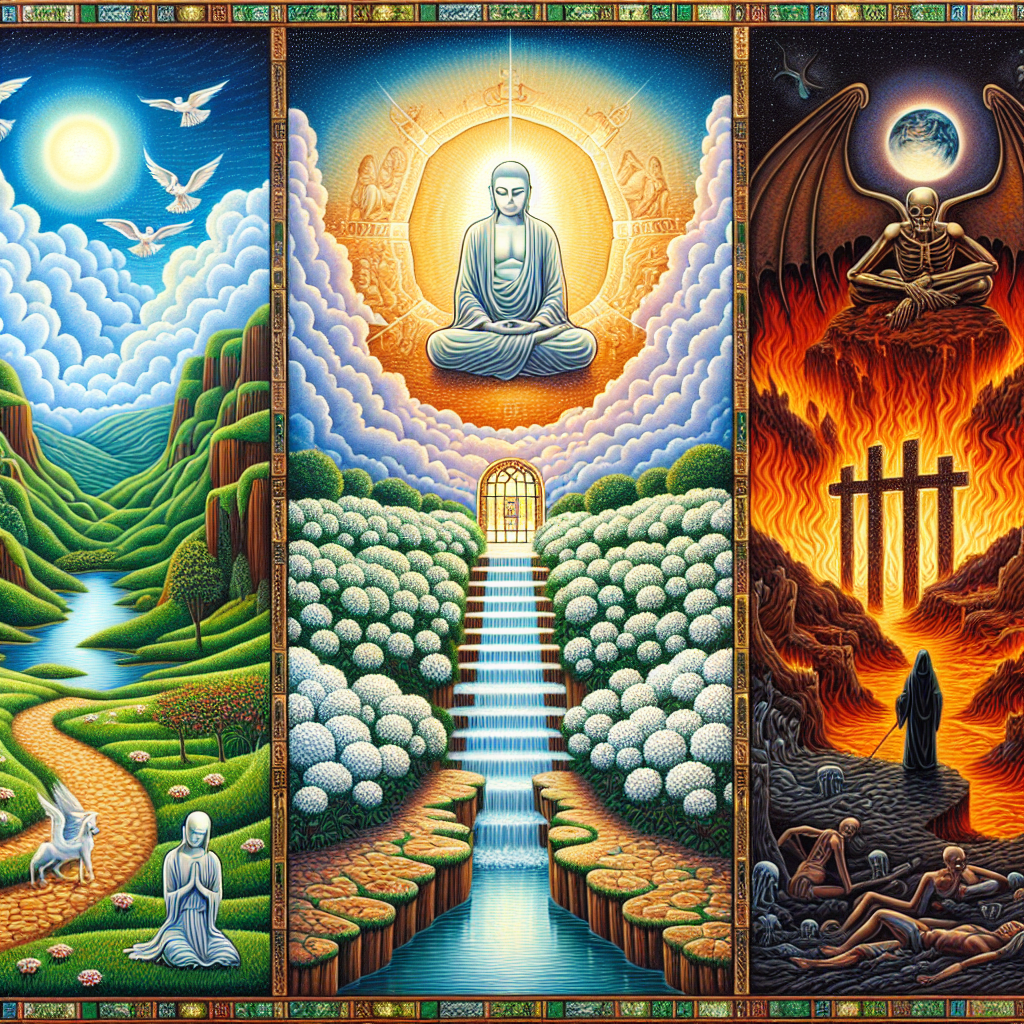
Imagine a world where the questions that have lingered in your mind about what happens after we die are finally answered. How do different religions interpret the afterlife? This article aims to bring you closer to understanding the various beliefs and perspectives when it comes to what awaits us on the other side. From the concept of reincarnation to heavenly realms and eternal punishment, embark on a fascinating journey through the diverse religious views on the afterlife. Prepare to be enlightened and amazed as we explore the mysteries beyond this earthly existence.
Christianity
Heaven and Hell
In Christianity, the afterlife is seen as a continuation of one’s existence after their physical death. It is believed that upon death, Christians face a judgment that determines their eternal fate. For those who have accepted Jesus Christ as their savior, the reward is heaven, which is depicted as a place of everlasting joy, peace, and communion with God. Heaven is described as a place free from pain, suffering, and sin, where believers are reunited with their loved ones and have eternal life in the presence of God. On the other hand, those who have not accepted Jesus and lived a life contrary to the teachings of Christianity are believed to be destined for hell. Hell is portrayed as a place of eternal punishment and separation from God, filled with suffering and anguish. It is seen as a consequence of rejecting God’s love and choosing a life of sin.
Judgment Day
Christianity also holds the belief in a final Judgment Day, also known as the Last Judgment or the Day of Reckoning. It is believed that on this day, all people who have ever lived will be resurrected and brought before God for judgment. Their deeds, actions, and faith will be evaluated, and their eternal fate will be determined accordingly. This day is seen as a time when justice will be served, and the righteous will be rewarded while the wicked will face punishment. The concept of Judgment Day serves as a reminder for Christians to live according to their faith, following the teachings of Christ and seeking forgiveness for their sins.
Purgatory
While not all Christian denominations believe in the concept of Purgatory, it is a belief held by some. Purgatory is seen as a temporary state or place where souls undergo purification before entering heaven. It is believed that those who have died in a state of grace but still have unconfessed sins or unresolved earthly attachments may need to undergo this process of purification. Purgatory is seen as a merciful concept, as it offers an opportunity for souls to be cleansed and made ready for the fullness of heaven. The length of time spent in Purgatory is believed to depend on the individual’s spiritual condition and the prayers and intercession of the living.
Resurrection
Resurrection is a fundamental belief in Christianity, which teaches that Jesus Christ was resurrected from the dead, conquering death and offering hope of eternal life to all believers. It is believed that at the end of time, there will be a general resurrection of all the dead, where their bodies will be reunited with their souls. This resurrection is seen as a transformation from mortality to immortality, where believers will receive glorified bodies and experience eternal life in the presence of God. The concept of resurrection emphasizes the belief in the ultimate victory over death and the assurance of the believers’ faith.
Islam
Paradise and Hell
In Islam, the afterlife is a significant part of the faith, with a strong emphasis on reward and punishment. It is believed that after death, individuals will face their eternal destiny based on their beliefs and actions in this life. Those who have lived a righteous life and followed the teachings of Islam are promised paradise, also known as Jannah. Paradise is described as a place of bliss, filled with eternal pleasures, where believers will be in close proximity to God. It is depicted as a vibrant and beautiful garden with rivers of milk, honey, and wine, and where believers will be surrounded by loved ones, enjoying eternal peace and happiness. On the other hand, those who have committed grave sins and have rejected the teachings of Islam are believed to be destined for hell, known as Jahannam. Hell is described as a place of punishment and torment, where sinners face eternal suffering and separation from God.
Day of Judgment
Islam strongly believes in the Day of Judgment, also known as the Last Day or the Day of Reckoning, which is believed to be a time of ultimate justice and accountability. Muslims believe that on this day, all souls will be resurrected and brought before God to be judged based on their deeds and faith. It is believed that every individual will be held accountable for all their actions, good or bad, and will be rewarded or punished accordingly. The belief in the Day of Judgment serves as a reminder for Muslims to live a righteous life, fulfill their religious obligations, and seek forgiveness for their sins, as it is believed that their actions in this life will determine their eternal fate.
Barzakh
Barzakh is a concept in Islam that refers to the intermediate realm between death and the Day of Judgment. It is believed that after death, the soul enters into the state of Barzakh, where it remains until the Day of Judgment. In this state, individuals experience a sort of afterlife, where the righteous are granted provisions and comforts, while the wicked face punishment and torment. Barzakh serves as a transitional period, where the soul is awaiting resurrection and the final judgment. The concept of Barzakh emphasizes the idea of a conscious existence after death but before the ultimate fate is determined.
Resurrection
Similar to Christianity, Islam believes in the concept of resurrection. It is believed that on the Day of Judgment, all souls will be resurrected, and their bodies will be reunited with their souls. The resurrection is seen as a physical event, where every individual will be raised from the dead and stand before God for judgment. This belief emphasizes the unity of body and soul and highlights the significance of the physical aspect of human existence. The resurrection serves as a reminder to Muslims of the significance of their actions in this life, as they will be accountable for them in the eternal life to come.
This image is property of images.pexels.com.
Hinduism
Reincarnation
Hinduism holds the belief in reincarnation, also known as samsara. It is considered a central concept that revolves around the cycle of birth, death, and rebirth. According to Hindu belief, the soul is immortal and continues to take birth in different bodies, experiencing various lifetimes. The specific conditions and circumstances of each life are believed to be determined by the individual’s actions in their previous lives, known as karma. Reincarnation is seen as an opportunity for the soul to learn, grow, and evolve spiritually, until it reaches a state of liberation from the cycle of samsara.
Karma and Moksha
Karma is a fundamental belief in Hinduism that governs the cycle of reincarnation. It is the notion that each action, whether good or bad, has consequences that will affect the individual in their current or future lives. The law of karma teaches that one’s actions in this life will determine the circumstances and experiences of their future lives. It emphasizes personal responsibility and accountability for one’s actions. Moksha, on the other hand, is the ultimate goal in Hinduism, representing liberation from the cycle of samsara. It is believed that by attaining moksha, the soul escapes the cycle of birth and death, reuniting with the divine and experiencing eternal bliss.
Samsara
Samsara is the continuous cycle of birth, death, and rebirth in Hinduism. It is believed that the soul, known as Atman, goes through numerous lifetimes, taking birth in different bodies in different realms or lokas. The specific realm or loka in which the soul is reborn is determined by the previous actions and karma of the individual. Samsara is viewed as a cycle of suffering and attachment, where individuals are trapped in the material world. The goal in Hinduism is to break free from this cycle and attain moksha, ending the perpetual cycle of samsara.
Heaven and Hell
In Hinduism, the concepts of heaven and hell are not as prominent as in other religions. Instead, the focus is primarily on the cycle of samsara and the pursuit of moksha. However, Hinduism acknowledges the existence of different realms or lokas, each providing a certain level of divine experiences and opportunities for spiritual growth. The highest realms, such as Vaikuntha and Kailash, are considered divine abodes where the gods and goddesses reside. These realms are associated with divine bliss and happiness. On the other hand, there is also recognition of lower realms, known as naraka, where individuals may experience suffering and pain. These realms are not eternal, but rather temporary, serving as opportunities for spiritual growth and purification before they are eligible for higher realms or liberation from samsara.
Buddhism
Nirvana
In Buddhism, the ultimate goal is to attain Nirvana, which is seen as a state of complete liberation and enlightenment. Nirvana is often described as the cessation of suffering, desires, and illusions. It is the state in which an individual is free from the cycle of birth, death, and rebirth. Attaining Nirvana is considered the highest spiritual achievement, where one achieves ultimate peace, wisdom, and the end of all cravings. It is believed that through the practice of meditation, mindfulness, and following the teachings of Buddha, one can achieve liberation from suffering and reach Nirvana.
Karma and Rebirth
Karma is a key concept in Buddhism, similar to Hinduism. It is the belief that every action, intention, and thought has consequences. The law of karma teaches that these consequences will affect individuals in their current life and future lives. The quality and intention behind one’s actions determine the nature of their future rebirths. Rebirth is seen as a continuous cycle of existence, where individuals’ souls are reborn in different bodies based on their karma. Buddhism views rebirth as an opportunity for spiritual growth and development, providing individuals with the chance to achieve liberation from the cycle and ultimately reach Nirvana.
Bardo
Bardo is a significant concept in Tibetan Buddhism that refers to the intermediate state between death and rebirth. It is believed that after death, the consciousness goes through different stages in the Bardo, each lasting a varying duration. The process of Bardo is seen as a crucial time for the individual to recognize the true nature of reality and make progress on their spiritual path. It is believed that during the Bardo, the soul experiences various visions, which can be influenced by their attachments, desires, and unresolved issues from their previous life. The ultimate goal during the Bardo is to attain a higher and more favorable rebirth or achieve liberation and attain Nirvana.
Heaven and Hell
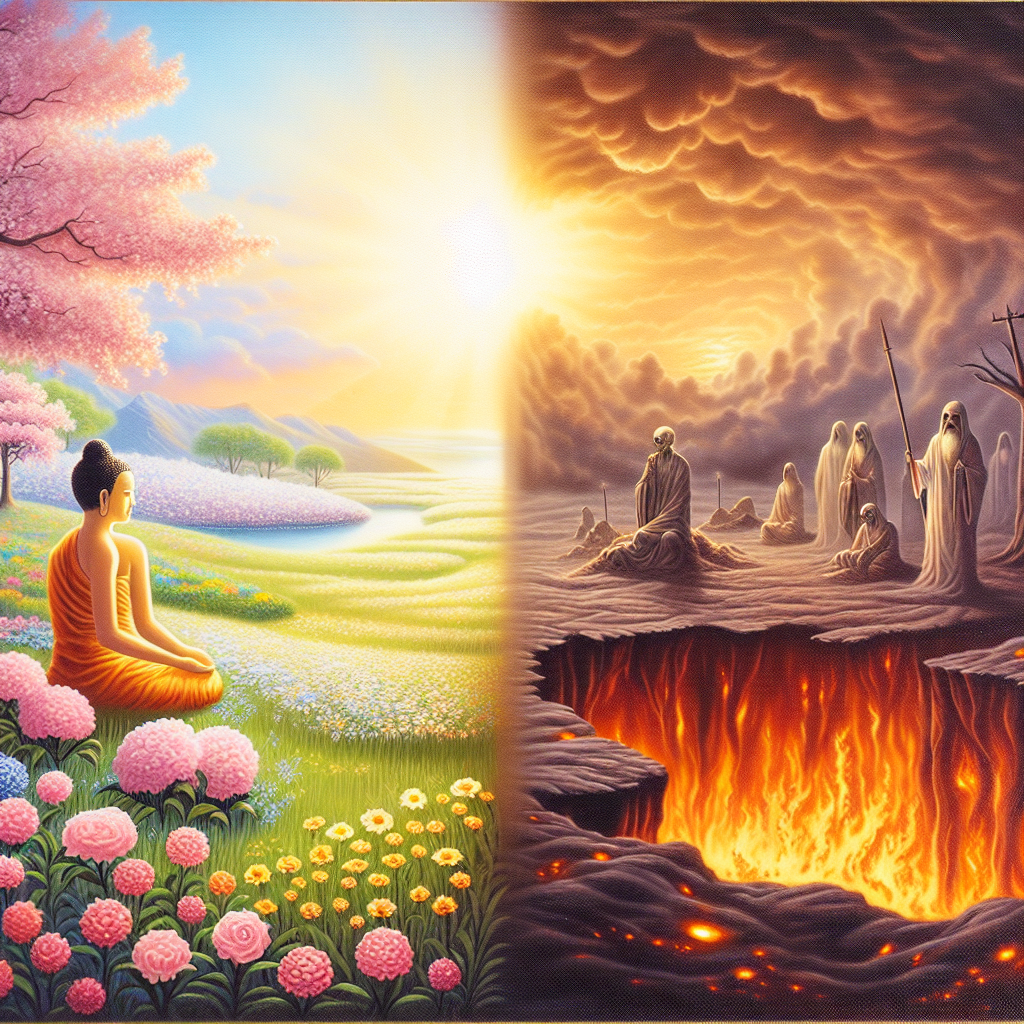
Unlike some other religions, Buddhism does not have a specific concept of heaven or hell as eternal realms. Instead, Buddhism focuses on the concept of realms or planes of existence, known as the Six Realms. These realms are divided based on the quality of existence and the level of suffering present. The realms range from the heavenly realms, where beings experience bliss and enjoyment, to the hell realms, where intense suffering is prevalent. However, Buddhism emphasizes the impermanence and transient nature of these realms, highlighting that all beings in these realms are still subject to the cycle of birth and death. The pursuit of liberation from this cycle and the attainment of Nirvana is considered the ultimate goal in Buddhism.
This image is property of images.pexels.com.
Judaism
Sheol
In Judaism, Sheol is often referred to as the grave or the place of the dead. It is described as an underworld or pit, where the souls of the deceased go after death. Sheol is believed to be a dark and gloomy place, where there is no active punishment or reward. It is seen as a realm of rest or sleep, where the souls await the ultimate judgment and resurrection. In Jewish belief, Sheol is not seen as a place of punishment but rather a temporary state of the soul.
Olam ha-Ba
Olam ha-Ba, which translates to “the world to come,” is the Jewish concept of the future life after the resurrection of the dead and the final judgment. It is believed that after the Messiah comes and the dead are resurrected, all souls will be judged by God based on their deeds and faith during their lifetime. Olam ha-Ba is seen as a time of reward and ultimate redemption, where the righteous will enjoy eternal life in the presence of God. The specific details of Olam ha-Ba are not clearly defined in Jewish teachings, as Judaism primarily focuses on the importance of living a righteous life in this world.
Resurrection
Resurrection is a fundamental belief in Judaism, which teaches that the dead will be resurrected at some point in the future. It is believed that God has the power to resurrect the dead and reunite their souls with their bodies. Resurrection is associated with the concept of Olam ha-Ba, where the righteous will be rewarded and have everlasting life. Judaism emphasizes the importance of leading a righteous life and fulfilling the commandments in preparation for the future resurrection and eternal life.
Heaven and Hell
In Judaism, the concepts of heaven and hell are not as prominent as in some other religions. While there is mention of a heavenly realm and a place of suffering for the wicked, the focus of Judaism is more on the present life and the observance of God’s commandments. Judaism teaches that individuals are responsible for their actions and should strive to lead a righteous life in this world. The primary focus is on living a moral and ethical life, rather than solely focusing on the reward or punishment in the afterlife. Judaism places a strong emphasis on the belief in the ultimate redemption of the world rather than the individual’s eternal fate.
Sikhism
Union with God
In Sikhism, the ultimate goal is to achieve union with God, known as Mukti or liberation. It is believed that the soul is eternally connected to God but is separated due to ignorance and attachments. By following the teachings of the Sikh Gurus, practicing meditation, and living a virtuous life, individuals can attain a state of union with God. This state of union is seen as a state of eternal bliss and freedom from the cycle of birth and death.
Karma and Reincarnation
Sikhism believes in the law of karma and the concept of reincarnation. It is believed that every action, thought, and intention has consequences that will affect individuals in this life and future lives. The cycle of birth, death, and rebirth is seen as an opportunity for the soul to learn and evolve spiritually. The quality of one’s actions and spiritual progress in each life will determine the nature of their future rebirths. Sikhism teaches that the ultimate goal is to break free from this cycle and achieve union with God.
Heaven and Hell
In Sikhism, the concepts of heaven and hell are not described as eternal realms. Instead, heaven and hell are seen as temporary states that individuals experience based on their actions and spiritual progress. The goal in Sikhism is not to strive for a specific heavenly realm, but rather to achieve union with God. It acknowledges that there can be heavenly experiences and blissful states in this life and the afterlife, as well as suffering and negative experiences. Sikhism emphasizes the importance of living a life of righteousness and devotion to God, rather than being solely focused on the attainment of heaven or the avoidance of hell.
Mukti
Mukti, also known as liberation, is the ultimate goal in Sikhism. It is the state of complete union with God and the end of the cycle of birth, death, and rebirth. By practicing the teachings of the Sikh Gurus, meditating on God’s name, and living a life of righteousness and selflessness, individuals can attain liberation and experience eternal bliss. Sikhism teaches that through devotion and love for God, one can break free from the cycle of suffering and attain Mukti.
This image is property of images.pexels.com.
Jainism
Moksha
Moksha is the ultimate goal in Jainism, representing liberation from the cycle of birth, death, and rebirth. It is believed that every soul, known as Jiva, is inherently pure and divine, but is bound by karma, which causes attachment and suffering. By following the path of non-violence, truth, and ethical conduct, individuals can free their souls from the cycles of samsara and achieve moksha. Moksha is seen as a state of eternal bliss, where the soul is completely liberated from the material world.
Karma and Reincarnation
Jainism, similar to Hinduism and Buddhism, believes in the law of karma and the concept of reincarnation. It is believed that every action, thought, and intention has consequences that will affect individuals in this life and future lives. The cycle of birth, death, and rebirth is seen as an opportunity for the soul to purify its karma and progress on its spiritual journey. Jainism places a strong emphasis on ethical conduct and non-violence, as these are seen as essential for breaking free from the cycle of reincarnation and achieving moksha.
Heaven and Hell
Jainism recognizes the existence of heavenly and hellish realms. The heavenly realms, known as Deva Loka, are seen as places of bliss and enjoyment, where individuals experience happiness and a higher level of existence due to their good karma. On the other hand, the hellish realms, known as Naraka, are realms of suffering and pain, where individuals face the consequences of their bad karma. However, Jainism teaches that both heaven and hell are temporary states, subject to the cycle of birth, death, and rebirth. The ultimate goal in Jainism is to break free from this cycle and attain moksha, which transcends the transient nature of both heaven and hell.
Akasha
Akasha is a concept in Jainism that refers to the eternal and infinite space. It is believed that all souls, liberated or bound, exist in the Akasha. The Akasha is seen as the purest form of existence, where souls are free from all attachments and delusions. It is associated with the state of ultimate liberation and moksha, where the soul is completely free from the cycles of birth, death, and rebirth. The concept of Akasha reinforces the idea of the eternal nature of the soul and the potential for liberation from the material world.
Zoroastrianism
Heaven and Hell
In Zoroastrianism, the afterlife is characterized by the existence of heaven and hell. The righteous are believed to be rewarded with eternal bliss in heaven, known as Garo Demana or the House of Song. Heaven is described as a place of light, joy, and harmony, where individuals are united with Ahura Mazda, the supreme god of Zoroastrianism. It is believed that the souls of the righteous bask in eternal happiness and enjoy the rewards of their good deeds in this life. On the other hand, the wicked are believed to face eternal punishment and suffering in hell, known as Duzakh or the House of Lies. Hell is described as a place of darkness, torment, and anguish, where individuals face the consequences of their evil actions in this life.
Judgment Day
Zoroastrianism believes in the concept of a final Judgment Day, known as Frashokereti. It is believed that at the end of time, Ahura Mazda will resurrect the dead and judge every soul based on their deeds in this life. The souls of the righteous will be separated from the wicked, and their eternal fate will be determined. Frashokereti is seen as a time of ultimate justice, where good will triumph over evil, and the wicked will be held accountable for their actions. This belief serves as an encouragement for individuals to live a righteous life, following the teachings of Zoroastrianism and striving for the reward of heaven in the afterlife.
Resurrection
Zoroastrianism teaches the belief in resurrection, where the dead will be physically resurrected at the time of Frashokereti, the final Judgment Day. It is believed that the soul and body will be reunited, and individuals will face judgment based on their thoughts, words, and deeds in this life. Resurrection is seen as a restoration of the complete individual, where the righteous will receive their reward in heaven, and the wicked will face punishment in hell. The belief in resurrection emphasizes the importance of leading a righteous life and being accountable for one’s actions, as they will ultimately determine one’s eternal fate.
Frashokereti
Frashokereti, meaning “making wonderful,” is the concept of the final renovation of the world in Zoroastrianism. It is believed that at the time of Frashokereti, all the dead will be resurrected, and the world will be purified and renewed through a great cosmic event. It is seen as a time of ultimate justice, where good and righteousness will prevail over evil. The earth will be restored to its original perfect state, and there will be no existence of pain, suffering, or evil. Frashokereti is associated with the resurrection and the final judgment, where the eternal fate of souls will be determined, and the ultimate purpose of creation will be fulfilled.
Shintoism
Ancestors and Kami
In Shintoism, the afterlife is deeply connected to the belief in ancestors and the veneration of spirits known as Kami. Ancestors are highly respected and honored in Shinto traditions, as it is believed that they continue to exist and watch over their descendants. Ancestor veneration is an essential practice in Shintoism, where individuals pay homage and offer respect to their deceased family members. Alongside ancestors, Kami are also venerated in Shintoism. Kami are seen as spiritual forces or deities that inhabit various natural elements and phenomena. They are believed to have an influence on human affairs and are venerated for protection, guidance, and spiritual connection. While the concept of an afterlife in Shintoism may not emphasize specific realms or destinations, the belief in the continued existence of ancestors and the veneration of Kami are essential aspects of the faith’s conception of the afterlife.
Reincarnation
Shintoism generally holds the belief in reincarnation, although the concept may vary among different sects and interpretations. It is believed that after death, the soul goes through a process of reincarnation where it is reborn into a new body. The specific circumstances and realm of rebirth are believed to be influenced by one’s actions and spiritual progress in previous lives. Reincarnation serves as an opportunity for spiritual growth and learning, allowing the soul to evolve in its journey towards ultimate enlightenment. While the precise nature of reincarnation in Shintoism may not be clearly defined, the belief in the cyclical nature of life and existence is a fundamental aspect of the faith.
Heaven and Hell
In Shintoism, there is not a strong emphasis on specific concepts of heaven and hell as eternal realms. Rather, the focus is more on the present life and maintaining harmony with the natural world and spirits. Shintoism emphasizes living in harmony with nature, observing rituals and festivals, and seeking protection and guidance from Kami and ancestors. While there might be recognition of positive and negative consequences of one’s actions in this life, the emphasis is more on the earthly realm and the interconnectedness of all beings. Shintoism places great importance on leading a virtuous life and honoring spiritual beings rather than dwelling on the concepts of heaven and hell.
Meiji Restoration
The Meiji Restoration is a significant event in Shintoism’s history, which took place in Japan during the 19th century. It marked a period of great transformation and resurgence of Shinto beliefs and practices. During this time, there was a movement to restore and revitalize Japan’s traditional culture, including the veneration of Kami and the emphasis on Shinto rituals and festivals. The Meiji Restoration brought about changes in government policies, education, and society, with a focus on a unified sense of Japanese identity. It revitalized Shinto as the national religion and reinforced the importance of ancestral worship and reverence for Kami. The Meiji Restoration had a lasting impact on the development and preservation of Shintoism as a vibrant and significant religious tradition in Japan.
Bahá’í Faith
World to Come
In the Bahá’í Faith, the concept of the afterlife is referred to as the “World to Come.” It is believed that after death, the soul continues to progress and develop spiritually in realms that are beyond the comprehension of humans. The World to Come is seen as a realm of spiritual growth and the cultivation of virtues. Bahá’ís believe that the soul’s eternal journey encompasses many stages and realms, ultimately leading to a closer proximity and conscious awareness of God. The precise nature of the World to Come is not elaborated upon in great detail, as Bahá’í teachings emphasize the importance of focusing on one’s spiritual progress in this life rather than speculation about the specific details of the afterlife.
Judgment Day
The Bahá’í Faith also holds the belief in a future Judgment Day, where all souls will be held accountable for their deeds and actions in this life. While the exact nature and timing of the Judgment Day is not clearly defined in Bahá’í teachings, it is believed that God’s justice and mercy will be fulfilled. Bahá’ís believe that the purpose of the Judgment Day is to ensure justice and fairness in the next life, where each individual will face the consequences of their actions and intentions. The Judgment Day serves as a reminder to Bahá’ís to strive for righteousness, cultivate virtues, and fulfill their spiritual responsibilities in this life.
Heaven and Hell
In the Bahá’í Faith, the concepts of heaven and hell are not understood in a literal or physical sense. Instead, they are seen as symbolic expressions of spiritual realities. Heaven is described as a state of nearness to God and the attainment of spiritual virtues and perfections. It represents a realm of eternal progress, growth, and joy. On the other hand, hell is seen as a state of remoteness from God, characterized by the absence of spiritual virtues and the presence of negative qualities. It is seen as a condition of the soul rather than a specific place of punishment. Bahá’ís believe that the afterlife is a continuation of the soul’s journey towards God, with opportunities for growth and progress beyond the limitations of the physical world. The focus is on the spiritual transformation and the cultivation of virtues rather than the reward or punishment of individuals in specific heavenly or hellish realms.
Resurrection
The Bahá’í Faith teaches the belief in resurrection, but the concept is understood in a metaphorical and spiritual sense rather than a physical one. It is believed that after death, the soul is resurrected and continues its eternal journey towards God. The resurrection is seen as a metaphor for the soul’s release from the limitations of the material world and its progress towards spiritual realms. It represents a transformation and a closer connection with God. Bahá’ís understand the resurrection as a spiritual reality rather than a physical event. The emphasis is on the eternal nature of the soul and its potential for spiritual growth and development in the afterlife. The belief in resurrection serves as a reminder for Bahá’ís to live a life of virtue, prepare for the next life, and fulfill their spiritual obligations.